Negar Hosseiniyan: Ultrasmall Gold Nanoclusters-Based Nanocomposites for Light-Induced Theranostics and Biosensing
Aalto University
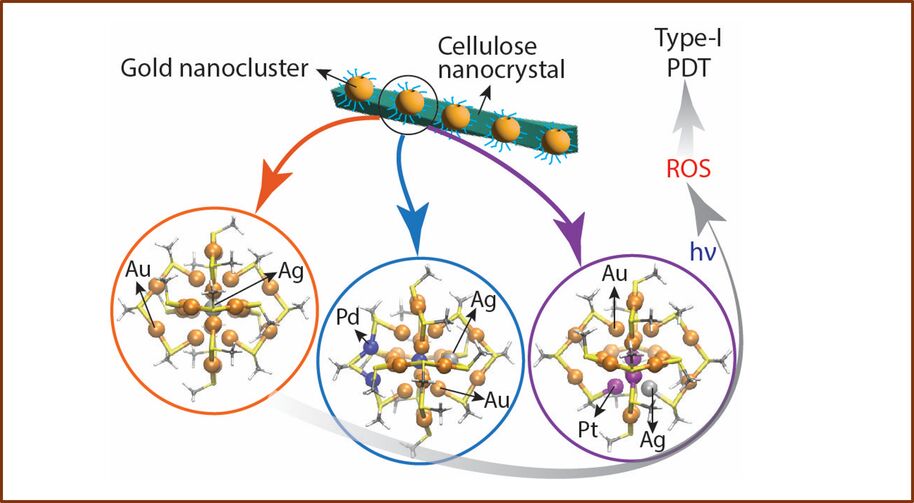
Atomically precise gold nanoclusters (AuNCs) have emerged as an active area of great interest due to their ultra-small size (usually < 2 nm), discrete energy levels and most importantly their intrinsic biocompatibility. They are behaving in between the atoms and metal nanoparticles. Unlike plasmonic gold nanoparticles, structural control (number of atoms, crystal structure and surface) of the Au-cores in AuNCs generates specific bandgaps. As a result, AuNCs exhibit tunable optical properties that make them promising candidates for light-driven biomedical applications, particularly in the realm of imaging, sensing and theranostics. In this present study, we investigate nanocluster-based nanocomposites designed to overcome limitations of conventional photosensitizers and sensing platforms. This report presents two key results demonstrating the potential of ultrasmall AuNCs for light-driven theranostics and biosensing applications. Bioderived cellulose nanocrystal–supported AuNCs (CNC–AuNCs) with selective mono- and multi-heteroatom (Ag, Pd, and Pt) substitution have been developed as Type-I photosensitizers. Heteroatom incorporation modulates photoluminescence and excited-state relaxation kinetics while maintaining high biocompatibility. Under light irradiation, nanocluster excited-state pathways enable efficient free-radical–mediated reactive oxygen species generation, leading to effective Type-I photodynamic cell destruction. This approach doesn't rely on external oxygenation and may potentially be effective on hypoxia-responsive imaging and photodynamic therapy.
In parallel, a light-driven biosensing strategy has also been developed to overcome limitations of conventional single-mode biosensors for trace biomarker detection. In this context, ultrasmall AuNCs have been integrated with two-dimensional nanosheets to create hybrid nanocomposites operating via a photoinduced electrosynchronics mechanism, where photoactivation synchronizes optical and electrochemical transduction. This approach enables amplified detection of uric acid at ppm levels, while the biosensor remains largely inactive in the absence of light, highlighting the essential role of photoinduced interfacial charge transfer. Future work will focus on optimizing ligand type and nanocomposite composition to extend this approach toward selective and multi-analyte biosensing.