Adil Mehmood: Bio-based Materials for Sustainable Electronics
Åbo Akademi University
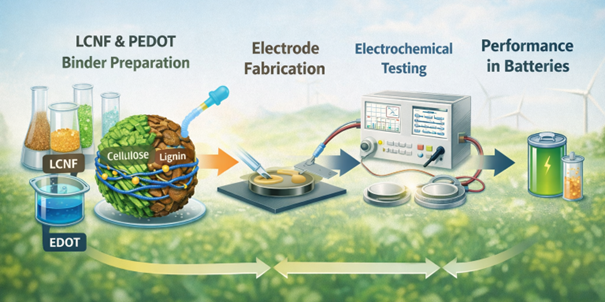
The growing demand for sustainable energy storage has intensified interest in bio-based alternatives to conventional synthetic binders such as polyvinylidene fluoride (PVDF) currently used in lithium-ion battery electrodes. PVDF dependency on toxic solvents during electrode processing raises significant environmental and health concerns, creating a strong need for greener functional alternatives. This study investigates the surface polymerization of 3,4-ethylenedioxythiophene) (EDOT) onto lignin-containing cellulose nanofibrils (LCNF) to develop electrically conductive composite films as sustainable binders for battery electrode applications. LCNF substrates with systematically varying lignin contents are prepared to examine how lignin concentration influences the electrical conductivity of the resulting composites. Lignin, as a naturally occurring aromatic polymer, is hypothesized to enhance interfacial interactions with the conjugated PEDOT backbone, promoting charge transport pathways across the nanofibril network. The prepared PEDOT-LCNF composite binders are to be evaluated against commercially available PVDF and carboxymethyl cellulose (CMC) binders through comparative analysis of cycling stability, rate capability, and interfacial resistance. This work aims to establish that tuning lignin content and introducing surface charge are effective strategies for optimizing bio-derived binder conductivity, offering a promising and environmentally responsible pathway toward replacing synthetic binders in next-generation battery electrodes.